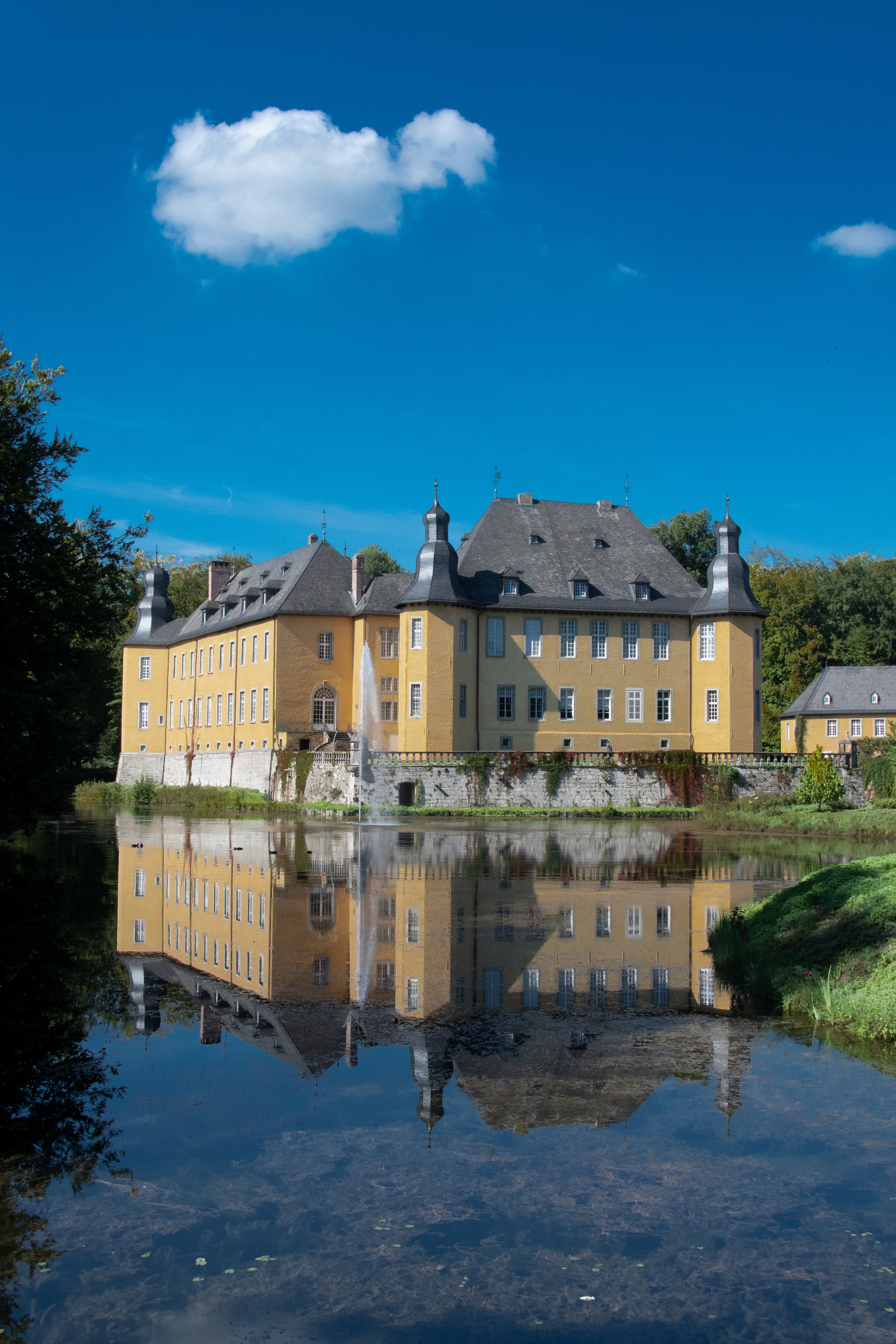


Dyck Castle
Schloss Dyck is one of the most significant moated castles in the Rhineland region of Germany, documented as early as 1094. Its origin is linked to the knight Hermannus de Disco, who appeared in records as the lord of a simple fortification under the Archbishop of Cologne. Initially, the structure was a modest defensive site on marshy ground, which over generations evolved into a fortified moated castle, integrated with surrounding villages to form a local power base.
The strategic location of Dyck Castle meant it played a notable role in the turbulent medieval period. It stood at the crossroads of influential regional powers: the Electorate of Cologne, Guelders, and Jülich. Over the centuries, the estate retained a remarkable degree of autonomy despite the shifting political landscape in the Rhineland. This independent territory came to be known as the Dycker Ländchen and remains distinct in the local cultural landscape today.
A major episode in the history of Dyck Castle occurred in 1383 when it was besieged by an alliance comprising the cities of Aachen and Cologne, Archbishop Friedrich III von Saarwerden, and Duke William I of Guelders and Jülich. These forces accused the castle’s lord, Gerard van Dyck, of being a robber knight, a term used for nobles who resorted to banditry. The siege ended the Dyck lineage’s male line, and the castle passed into the possession of the Reifferscheid family, specifically Johann V von Reifferscheidt, whose descendants would rule the estate for over 900 years.
During the late Middle Ages and into the early modern period, the castle's defensive role diminished as the feudal world gave way to more stable structures. The 17th century saw significant improvements and expansion under Count Salentin von Salm-Reifferscheidt. Between 1656 and 1667, Dyck was transformed from a fortress into a baroque residential palace, with the addition of a four-winged main building, stables, a guard room, and a brewery house, reflecting its transition to a seat of noble life rather than warfare.
Though Dyck Castle’s military significance reduced after the medieval period, the surrounding region was not immune to upheaval. The Rhineland saw destructive campaigns during the Thirty Years’ War (1618–1648) and the Nine Years’ War (1688–1697), conflicts that devastated swathes of western Germany and included the destruction of nearby castles and towns. However, there is no specific record that Dyck Castle itself was a direct battlefield or seriously damaged in these wars. This relative security may be attributed to its status, local power, and diplomacy.
In the late 18th century, Schloss Dyck transitioned into a Rococo residence, renowned for luxurious interiors, including exquisite wallpapers and fine furniture. The East Wing now serves as a museum, offering a glimpse into the castle’s glorious past. Unfortunately, significant artifacts, such as the library and armory, were lost or sold in the 20th century.
By the 19th century, under the direction of Prince Joseph zu Salm-Reifferscheidt-Dyck, the castle grounds were transformed into an English landscape garden with the help of Scottish gardener Thomas Blaikie. This park remains one of the most remarkable features of the estate, reflecting both status and an enhanced focus on aesthetics and leisure.
Throughout its history, the castle complex, with its four islands, remained not just a residence but the administrative center for its estate, overseeing the management of surrounding lands and integrating new design and utility features over time. The unity of domestic quarters and supply houses at Dyck is a defining characteristic that underlines its role as both a noble seat and economic hub.
Today, Schloss Dyck operates as the Centre for Garden Art and Landscape Design under the Stiftung Schloss Dyck Foundation, established in 1999. The castle and its extensive grounds are open to the public, serving as a vital center for cultural and historical education, events, and tourism, while preserving over 900 years of the region’s history within its walls.