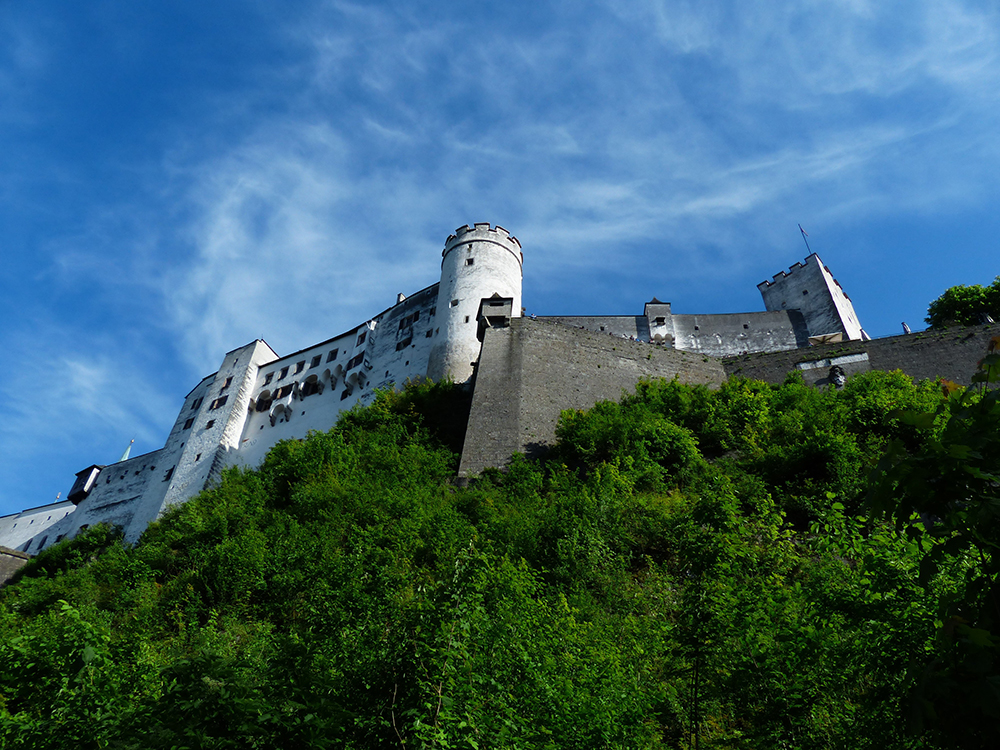


Hohensalzburg Castle
Hohensalzburg Castle, situated atop a hill in the Austrian city of Salzburg, boasts a rich and fascinating history that spans over a thousands years. This imposing fortress, one of the largest existing medieval castles in Europe, has witnessed numerous battles and has played a significant role in the region's history.
The origins of Hohensalzburg Castle can be traced back to the 11th century when Archbishop Gebhard von Helfenstein ordered its construction. Its primary purpose was to serve as a protective stronghold against potential invaders. Over the centuries, the castle was expanded and fortified by successive archbishops, who made it their main residence and stronghold.
The first major battle in the history of Hohensalzburg Castle occurred in 1077 when Henry IV, the Holy Roman Emperor, laid siege to the fortress. However, he and his forces failed to conquer the castle, and it remained firmly under the control of the archbishops.
During the 15th century, a power struggle known as the Salzburg War erupted between the archbishops and various local nobles seeking independence. The castle became a critical battleground during this conflict, with multiple sieges and skirmishes taking place. In the end, the archbishops emerged victorious, solidifying their hold over both the castle and the region.
In the early 16th century, the castle underwent significant expansion under Archbishop Matthaus Lang. He transformed Hohensalzburg into a magnificent Renaissance palace, adding elegant rooms and towers. This period of relative peace, however, was soon disrupted by the outbreak of the German Peasants' War in 1525. The castle once again became a target, experiencing a brief occupation by the peasant army before the archbishop's forces regained control.
Another significant siege occurred in 1800 during the Napoleonic Wars. The French army, under the command of General Jean Victor Marie Moreau, bombarded the castle in an attempt to force its surrender. The archbishop's men valiantly defended the fortress, and after several days of fierce fighting, the French troops were repelled.
In the 19th century, Hohensalzburg Castle lost its military importance and served primarily as a symbol of Salzburg's history and power. In 1918, the last archbishop left the castle, marking the end of its occupation by the church.
During World War II, the castle escaped major damage despite Salzburg being a target for Allied bombings. It served as a refuge for thousands of residents seeking shelter from the destruction in the city below.
Today, Hohensalzburg Castle stands as a testament to the architectural prowess and military strategies of past generations. It attracts numerous visitors who explore its vast complex, including the Rainer Regiment Museum, showcasing the history of the castle and the archbishops' army.
While many battles have taken place in and around Hohensalzburg Castle, it has remained impregnable for most of its existence. Its strategic location on a hill provided a natural advantage, and its well-designed fortifications deterred would-be conquerors. The castle's impressive history, combined with its stunning panoramic views and architectural beauty, offers visitors a unique opportunity to step back in time and relive the struggles and triumphs of the past.